Indian Elections have over time undergone manifold ups and downs as our democracy has gradually evolved through different emerging facets. The oscillations, besides other things, also included a muddy show of muscle power to money power and perpetrated violence to political manipulations. Finally, we have witnessed the emergence of a stable, strong, transparent and zero-error system that was ushered in by professionally managed ECI through the awakening of our Civic Society and the necessary adoption of distinctive strategies. These drives made a difference, encompassing, technology driven logistics, dynamic force-deployment modules, multilayer planning & supervision by different sets of capable observers. 2014 elections are on the anvil and it would be appropriate to glance through certain facts.
To recall, in the 2019 Parliamentary election, 912 million people were eligible to vote and 67% voters exercised their franchise spread over a period of 40 days. It was decided to conduct elections in 7 phases. The periodical exercise commences with ECI consulting various stakeholders, primarily the MHA and the State administrations in order to determine the proper timing, required resource mobilization, appropriate capacity building and generation of proactive responses. By now ECI has already put in place various checklists and standard operating procedures besides a set of model codes of conduct for a motley of stakeholders. Consequent to various judicial pronouncements including the landmark judgment of Hon’ble Supreme Court on deployment of CAPFs, Election Commission has also drawn detailed guidelines on the role of the central as well as state apparatus.
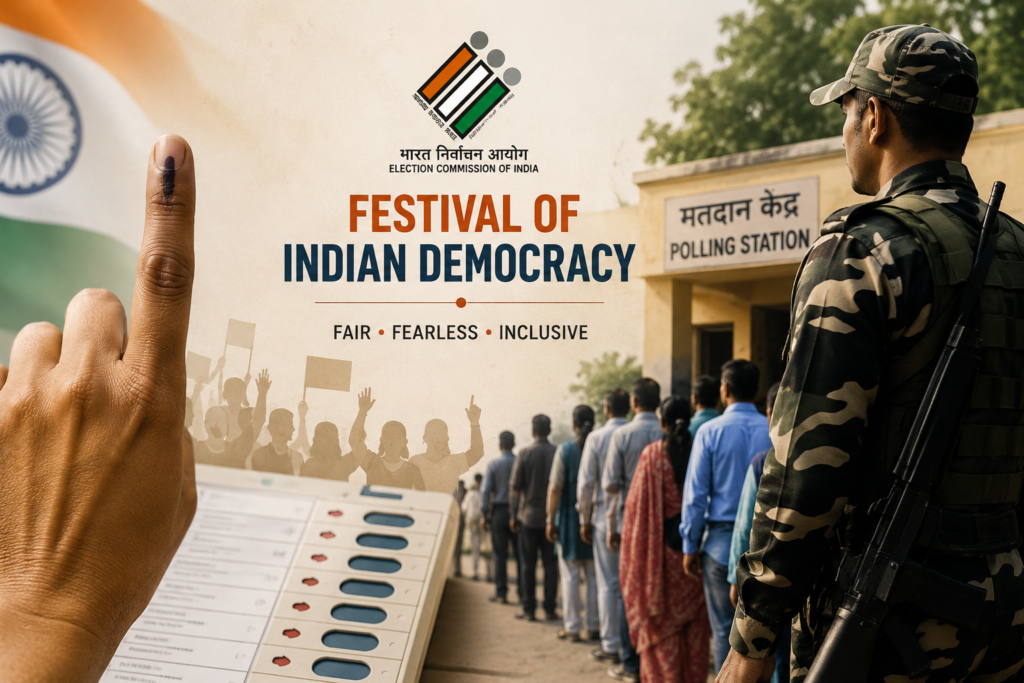
All those involved in the process of elections are deemed to be on deputation to the ECI. Over 3 lac Central Forces and 20 lacs state police personnel were deployed during the last elections of 2019 and the earlier elections. The role of CAPFs for diverse purposes includes area dominance or flag march, security of EVMs, security of polling centres and booths, layered mobile security around the polling booths, if need be, in accordance with the guidelines of the ECI. Such is the sanctity given to CAPF that polling on the booth will not commence till the CAPF arrives. The entrance of the given booth or the clusters of booths is under the direct control and watch of the CAPF. The Booth is under the command of the presiding officer. However, CAPFs report the chain of events at the booth through their channels as well. This is to depict the indispensability and empowerment mechanism of CAPF on the polling day.
On the other hand, state police has the responsibility of law & order, security in catchment areas (so that voters can freely move and vote of their free will), mitigating various vulnerabilities, creating a conducive environment through effective action against criminals or trouble makers, sealing the border, naka-checks, policing in the neighbourhood zone (100 meters of booth) and the restricted zone (200 meters of the booth) on the day of polling, access control as per identity card, checking of objectionable material, making of lines at the booth etc. Thus, there is complete role clarity. Task begins right from observance of Election Code of Conduct, filing nominations, monitoring road shows, securing public rallies and other methods of electioneering, and goes up to regulation of Vijay juloos in the post-election scenario.
One of the challenging tasks is the coordination between state apparatus and the CAPF. Though the ECI has defined all the logistics in terms of mobility camping, communication etc., further fine-tuning needs to be done. At times, endless bickering takes place. What needs to be underscored is the accountability of the coordinating force or nodal ranks on either side in order to ensure that the systems work. With real-time audio-visual tools, everything can be proactively conveyed to avoid any confusion. Then being compassionate is actually the ultimate key.
Past debriefing reports are well gone through to usher in the desired improvements in the system. Crisis or contingency management plans are put in place. Licensed arms need to be restricted through the committee of DM, SP and others as per the person specific assessment. Liquor bans are placed on given dates as per norms. Thus, all the supplementary aspects are also factored in.
All these preparations need to be revisited and further strengthened as the texture and tenor of the human terrain undergoes a change. The war of narratives and the tendency to make a vulgar display of one’s strength or engage in violence on the streets, as has been witnessed in the local body or other elections, remains a matter of grave concern. This throws onus on the local administration to mitigate all vulnerabilities and take timely action to neutralise any threat emanating from any end.
In a nutshell, the whole exercise needs to be seen in terms of the following core security related tasks-
– Optimizing the roles of various stakeholders
– Institutional empowerment for resource mobilisation & capacity building
– Voters’ awakening
– Domain demarcations at ground level
– Creating conducive environment & mitigating various vulnerabilities
– Deployment strategies
– Catchment area policing and special threat mitigation
– Enforcing election related laws and taking cognizance of various offences
– Creating level playing field for all
– Polling centre management
– Control room & reporting systems
Action on election related offences and vigilance on anti-democratic practices has been an area of serious concern in the past as well. As the data depicts, nearly 40% candidates had a criminal background in the earlier elections. A large number of election related offences were also booked, including seizure of objectionable material and currency. Special capacity building sessions are, therefore, held for police as well as other agencies for effective response mechanisms.
A final word of caution. All systems work only and only if those responsible at various levels don’t compromise their values. Using policing systems to harass a particular segment, putting them behind bars, creating false evidence, not creating a conducive environment, overloading the deviations of certain segments for various ulterior reasons are some of the instances that have at times come to the fore. Though in the present times, it is no longer easy to hide things, yet ‘damage once done is damage that is done for long’. Hence a detailed value orientation of those deputed in the election process is a must. Actually, ECI does conduct the HR checks, yet there is still room for much to be done in this respect.
(.)